A laboratory receives a packet of ten pieces of cannabis candy. The wrapper gives an amount of THC per packet and divides it into ten servings. Checking the first claim takes one kind of experiment. Checking that every piece delivers a tenth of the total takes another. A widely cited study of edible cannabis products made an especially clear choice between the two: the researchers mixed the entire contents before taking a sample.
From the dispensary shelf to a single mixture
In 2014, purchasers visited dispensaries in Los Angeles, San Francisco and Seattle. Working within a set budget in each city, they sought a variety of products and labeled cannabinoid amounts. Ryan Vandrey and colleagues ultimately analyzed 75 edible products. Their research letter in JAMA describes baked goods, drinks and candies or chocolates, all drawn from a particular medical cannabis market at a particular time.
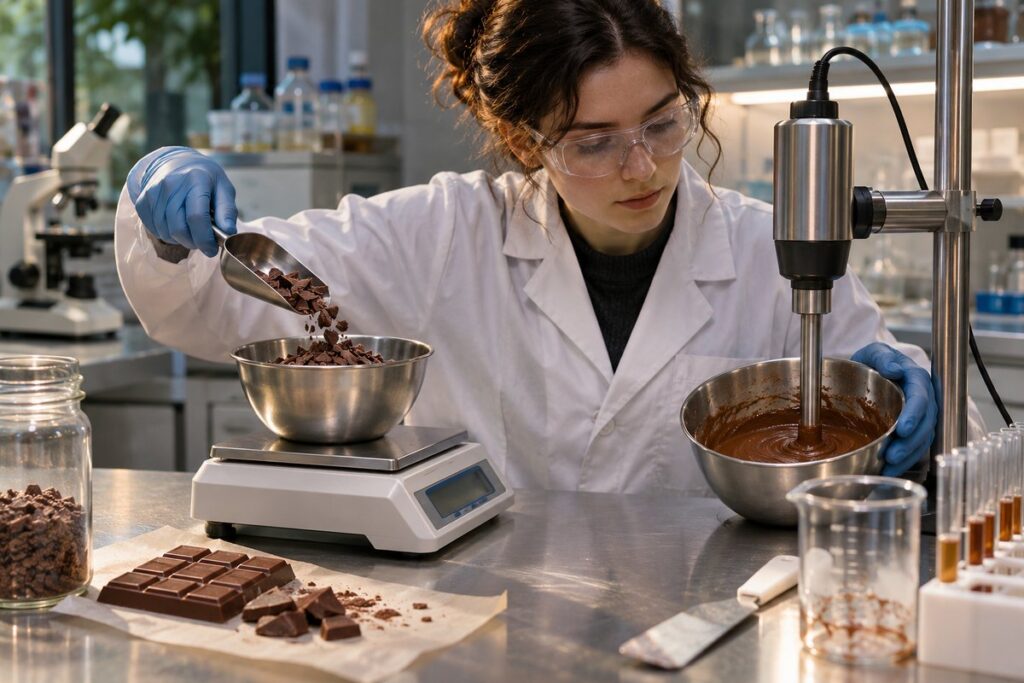
At the laboratory the entire contents of each package were crushed or mixed. Analysts took two portions of the resulting material and measured them using high-performance liquid chromatography, a method that separates compounds so that each can be quantified. Averaging the two results and accounting for the total product weight produced an estimate of the THC in the package. Two portions of the same mixture helped check the measurement without requiring the instrument to analyze an entire brownie or bottle at once.
Food makes this a more demanding job than measuring THC in a vial of solvent. Fat, starch and sugar arrive at the laboratory along with the compound of interest. Analysts need evidence that they can recover and measure cannabinoids in that particular material. A separate study of brownie quality-control samples illustrates how a familiar food can serve as a test of the measurement procedure itself.
Which side of the label was wrong?
The 2015 paper treated a result within ten percent of the labeled THC amount as accurate. Thirteen of the 75 products fell in that band. Forty-five contained less THC than the label indicated, and seventeen contained more. Saying which number was higher is clearer than calling an item “underlabeled,” a word readers can easily take to mean either the laboratory result or the label was too low.
Those counts apply to packages bought under the study’s sampling plan. Seeking a wide variety of items is a sensible way to discover that discrepancies exist across several forms of food. It provides little basis for calculating the odds that a randomly chosen edible on a shelf today has a particular error. A later investigation of online CBD extracts also compared laboratory findings with labels, but its products and market were different. Combining the percentages from the two studies would lose both distinctions.
The information lost in the mixing bowl
Imagine two packets, each labeled as containing 100 milligrams altogether. In the first, every one of ten pieces contains ten milligrams. In a deliberately extreme second packet, five pieces contain five milligrams each and five contain fifteen each. Both packets total 100 milligrams. If each entire packet were thoroughly mixed and analyzed perfectly, the report for one could look exactly like the report for the other.
To study that difference, a laboratory would have to keep the individual pieces identifiable and analyze them separately. For a single scored bar, even the location of each square could be worth preserving. Multiple packets would then answer a further question about variation from package to package. Repeated readings from one well-mixed packet cannot substitute for those independent samples.
The original study made the package label answerable to a laboratory measurement. That achievement rests on the very step that erased any evidence of uneven portions. If a report gives a reliable package total, dividing by the number of servings yields an average. The contents of the particular square that broke off in someone’s hand remain a separate question. So does the ease with which someone reading the wrapper can work out that average, a question examined in an experiment comparing serving labels.